Friday, February 29, 2008
A hearty Welcome to Doha !
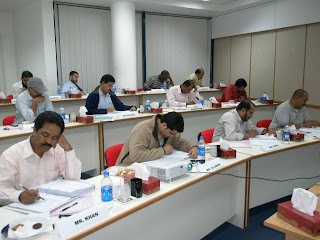
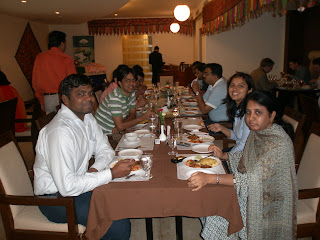
We kickstarted the 96th Pmdistilled program at Doha, organized by Syscoms. There are 15 delegates from IT, Electrical, Civil engineering streams. I take this opportunity to thank all the delegates for choosing PMdistilled program and the smart team at Syscoms, Doha for making it a great success!.
Wednesday, February 27, 2008
Special thanks to Antony and Rathish !
Starting the Tour of the Middle East Tomorrow !
Tuesday, February 26, 2008
Saturday, February 23, 2008
Dear Ajith, May your soul rest in peace
Me and Ajith studied together at MSRIT for engineering, and we stayed together in a rented house near the college for five years. He is no more now ( a reality). Now, I can only pray for his soul and for the well being of his family.
To All
Attached is a message from Abraham George (Mech 1983 ) on Ajit Kumar TV
Abraham and Ajith are ex alumni from MSRIT and worked for Cardon (A1) in Philadelphia.
Ajith Passed away yesterday 22-Feb-08 in Philadelphia.
G Mathews
Dubai
Dear All,
Today I am writing to all of you after a long time for a very special reason. Our Ajith Passed-Away this evening after a fierce battle with cancer. He survived with his wife (Mini) and two children. I visited him a week ago and had a chance to talk to him for some time. At this time of grief other than prayers we could do very little.
Please keep him and his family in all your prayers.
I hope and pray this e-mail finds you all in good health and happiness. Please convey this message to all others who knows Ajith.
Abraham George
83 Mech.
Philadelphia
215-540-4420
Thursday, February 21, 2008
Measuring the strength of a workplace
1) Do I know what is expected of me at work?
2) Do I have the materials and equipment I need to do my work right?
3) At work do I have the opportunity to do what I do best every day?
4) In the last seven days, have I received recognition or praise for good work?
5) Does my supervisor or someone at work, seem to care about me as a person?
6) Is there someone at work who encourages my development?
7) At work, do my opinions seem to count?
8) Does the mission/purpose of my company make me feel like my work is important?
9) Are my co-workers committed to doing quality work?
10) Do I have the best friend at work?
11) In the last six months, have I talked with someone about my progress?
12) At work, have I had opportunities to learn and grow?
These 12 questions are the simplest and the most accurate way to measure the strength of the work place. A project manager’s challenge is to ensure that the team scores high on these 12 questions at every instance of project life span. Is it that difficult?. The answer is both 'YES' and 'NO'. It is not impossible at least.
Wednesday, February 20, 2008
Monday, February 18, 2008
Chance to review PMBOK 4th edition
Here is the exposure draft page
A visit to my old office after 16 years
PMO alignment
1) Selection of the project management tools
2) Training on the project management methodolgy and tools
3) Helping project managers/teams on critical project management issues
4) Providing strategic input to the senior management related to project management competencies
Ideally PMO's should be equally aligned to the senior management as well as the project teams. In most of the PMO implementations, the PMO starts by aligning itself to the senior management, by providing the key data on project management to the senior management. While doing this, they tax the project teams for data, which the project teams consider as another necessary evil. Eventually PMO gets labelled as another audit function in disguise. At the same time it is very difficult for PMO's to get aligned to the project teams alone. A well balanced middle path is the best. PMOs should be both of "Consulting" and an 'Audit' mix, with more weightage to consulting.
PMO should be a right mix of Consulting and Audit
Sunday, February 17, 2008
Bangalore Hosur road fly over
- Widening the roads (which is already done, half heartedly)
- Enforcing traffic rules
- Constructing underpasses at the main junctions crossing the hosur road
Completed Pmdistilled at Sasken, Bangalore
Friday, February 15, 2008
todolist # 23 Critical chain project management
In conventional project schedules, buffers are built into activities, resulting in;
- Student syndrome (the task grows to occupy the time available)
- Buffers saved gets unutilized as the resource for the next task is available only after the scheduled duration of the earlier task. Let us say task A is the predecessor to task B and the duration of task A is 5 days with 2 days buffer built into it. Even if task A gets over on the 3rd day, without consuming the buffer of 2 days, the task B can start only on the 6th day, as the resource to execute task B will be available on the 6th day only.
For more, please follow this link
First PMdistilled program @ Muscat
Indian Projects worth USD 500 billion?
Arcelor Mittal's Jharkand plant ready to take off?... Project value - USD 20 Billion
Government identifies 10th ultra mega power project. The total cost of all these power projects = 1000000 Crores of Indian Rupees :-)
Reliance Industries, Jamnagar refinery expansion project - US$ 5.7 billion, to emerge as the world's largest single location refinery
TATA Nano, the world's cheapest car
Boeing and Tata JV to make aerospace parts
Why do India and other emerging markets are experiencing investment in these large projects?
These projects are becoming mandatory to sustain the enviable growth rates achieved by India (average 9% growth). In most of the places, the current infrastructure cannot support additional growth. Coupled with this, India need power to sustain it's growth. The attempt by the current government to sign an MOU with the US for nuclear cooperation did not materialize due to the opposition by the communist party of India. This situation will trigger the scope for more power related infrastructure projects.
Impact of these projects on community?
The impact of these projects on community are mixed. While the new projects benefits millions of Indians it has it's negative effects as well. A recent survey reveals that 77% of the Indian population failed to benefit from the boom. Ensuring the sharing of the benefits of the growing economy is a big challenge every Indian has to face, else it will increase the ditance between the haves and the have nots. Most of the mega infrastructure projects, diplaces the villagers from their natural habitats, depriving them of their livelihood and quality of life. Here are two classic examples of these;
How can project managers round the world can take advantage of the mega projects happening in India?
Yes, definitely this is a great opportunity for project managers with global exposure to venture into India. Especially in civil engineering, the Indian project managers lack exposure to the demands of these mega projects (technology, scales). This gives ample opportunities for project managers with international exposures to pitch in (20% of the pilots in India are non-Indians).
If you are a project manager on a mega project in India or another emerging market, what are the risks and how can best mitigate them?.
- So far, most of the foreigners have seen India in the capacity of either as a boss or collaborator or customer. Being a team member of an Indian project team can be a new experience. One has to be mentally prepared for it.
- Getting things done here is time consuming. One has to adjust to it.
- Government systems are not very transparent
- And, it is one of the biggest democracy. Everyone is aware of their rights :-). Human rights activists are very strong
Saturday, February 9, 2008
The journey continues
I am unable to upload any photos, as I forgot to bring the connecting cable of my camera (it is high time, these guys standardized the USB cables):-). Will upload them, as soon as I reach my office on the 17th. Tonight I am travelling to Muscat for the 94th batch of the PMdistilled program :-). From there I will be going to Bangalore.
Again, I take this opportunity to thank all the participants for choosing us their trusted partners in their project management career enhancement pursuits. Thanks team, and wish you all the best. Keep in touch !. Dont forget to shoot me an email, when you pass the PMP credential exam. It will make my day brighter :-)
Change India !
Thursday, February 7, 2008
@ Dubai
Wednesday, February 6, 2008
todolist#22 Control accounts
Example : - I am estimating for a software to be delivered in Jan 2009 and the RDBMS should be the then latest Oracle RDBMS the price of which is not known now. Still I may have to start work on it, without knowing how much it is going to cost.
In these circumstances, we open a control account (a provisional account) for those work packages, whose actual estimates are not yet known - and the work continues. Workpackages operating with a control account are definitely high risk items, and should be given top priority while monitoring and controlling them.
todolist # 21 - Bottom up estimation
Tuesday, February 5, 2008
My e-book - myPMguide ---- To be released soon
- Anyone who is interested in understanding professional project management
- Anyone who is implementing professional project management
- Abyone who is preparing for project management credentials like CAPM, PMP by PMI
Very often I get the answer as 'check emails'. What happens after that?. Very often, these emails decide our day. Our actions of the day are guided by these emails. If this is true with you (like many other thousands of project managers), then actually what you are doing is project coordination, not project management. Project management revolves around proactiveness, where as project ccordination revolves around reactiveness. We may not be able to eliminate reactiveness completely at the same time will be definitely able to tilt the table in favour of proactive management, by learning and adopting professional project management.
Every stream of management revolves around PDCA (plan-do-check-act) or PDSA (plan-do-study-act). Whatever we need to accomplish, plan first. Then execute the plan. Monitor and control the progress and then Close. When we translate this to project management, every project manager should know;
- How much work is involved in accomplishing the project's objective?
- How much calendar time it will take to complete this work?
- How much it will cost to complete this work?
- Where are we now with respect to work completion and budget consumption?
The following points will help you to start understanding and practising professional project management. It is easier than adhoc project management. Your quality of professional and personal life will be better.
As a professional project manager, one should;
- Understand the critical path of the project (the longest path in the project network, or the shortest time in which a project can be completed.
- Earned value of the project (the progress made - work completed)
Coverage of this book
myPMguide covers all the concepts explained in the project management body of knowledge (PMBOK) by PMI
My e-book series 'myPMguide' will help you to master professional project management. The release of this e-book is scheduled towards end of Feb - 08
Stakeholder management - Microsoft - Yahoo - Google
- a) Kill yahoo first
- b) Then manage google :-)
My personal view.
From the PMdistilled program, Bangalore, Feb 1,2,3
Keep in touch. AB
Our next program at Bangalore is during March 21,22,23
Monday, February 4, 2008
todolist#20 - Document and release the plan
- Project charter (either as a separate document or as part of the plan itself)
- The scope of work
- Roles and responsibilities of the team and the reporting structures
- Milestone chart
- Cost management plan - work package level budgets, team expenses and how to manage them
- Shortlisted risks and the risk management plan
- Schedule management plan, explaining the tools, templates, change management of schedule.
- Scope management plan - explaining how the changes to the scope will be manageged
- Human resource management plan - explaining the team ramp up and the ramp down pattern, strategies for acquiring the team, induction programs, training, motivational strategies etc.
- Quality management plan - containing the quality goals and the strategies to meet them, the metrics to be collected and the frequency of collection.
- Procurement plan - explaining what, where, when, how, how much of the purchases required for the project.
- Contract management plan - explaining how the contracts with the subcontractors and the customer will be managed.
- Communication management plan - explaining how the project communications will be managed.
I have come across teams, who does a brainstorming at the beginning of the project and theme is 'How can we ensure that this project is a failure?". Based on the brainstorming outcome, the team develops strategies to counter the risks and that becomes their project plan. Not a bad idea !. Once the plan is reviewed and approved, then it, along with the scope document forms the scope baseline.
Sunday, February 3, 2008
Alternatives # 1
http://www.agilejournal.com/articles/articles/the-agilev-scorecard.html
Saturday, February 2, 2008
todolist #19 Create multiple schedules if required
By giving only the milestone charts to the senior management, indirectly the project manager is shouldering more responsibility - and this is what is desired bahavior of the project manager - the ability to shoulder responsibilities.
Very often the project manager is forced to give a copy of the schedule to senior stakeholders. If this scenario is inevitable, then the ideal thing to do is to create multiple schedules;
- Create a pessimistic schedule, based on the pessimistic values (the highest) of estimates and give to the customer. It is always better to underpromise and over deliver !
- Create a most likely schedule, based on the most likely values of the estimates and give this to your immediate boss.
- Create an optimistic schedule (most agressive), based on the optimistic values of estimates. At the same time dont loose all the buffers. Arrive at the buffers by subtracting the optimistic estimate from the most likely estimates and create a buffer of these buffers towards the end of the milestones and the project (release the buffer from the activity level and create a buffer of buffers at the major milestone levels. The team will work based on the optimistic values (most aggressive) and in case there is a delay, as long as it is within the buffer limits, you are safe (one of the aspects of critical chain project management)
Friday, February 1, 2008
todolist # 18 - Create Schedule
- Create milestones. By and large, there will be a one to one mapping between the work packages (WBS) and the milestones. If the work packages are more aligned towards the 8 hours (8-80 rule, suggesting that workpackges should be between 8 hours and 80 hours), then one milestone may comprise of multiple work packages. If it is more aligned towards 80 hours, then there can be one to one mapping between the work pacges and milestones. There is no guideline stipulating this. The project manager has the complete authority to decide on this.
- Once the milestones are identified, then transfer the corresponding activities (from the activity lists of the corresponding work packages) under the milestone. Care should be taken to list them, based on their precedence (order of occurrence).
- At this stage, it is a good time to do a bottom up estimation (if not done earlier)
- Please ensure that the activities have appropriate buffers
- When we add up the estimates of the individual activities, it should tally with the top down estimates done earlier at the work package level. If there is a big variance, revisit the estimates and if required, re-negotiate based on the new information. No need to shy away from this, as "continuous elaboration" is a characterestic of every project.
- While creating the activities, create them by allocating just one resource, which can be optimized later. That means, if a particular activity comprises of 10 person days of effort, then the calender days required to complete the activity also will be 10, since only 1 resource is allocated against it.
- Steps 1,2,3 will give a semi cooked schedule with milestones and their pertaining activities, all starting on the same day and every activity is allocated with just one resource.
- Start sequencing these acticities based on their finish to start dependencies
- Load these activities with additional resources. Depending on the number of resources allocated, the durations will reduce.
- Do the resource levelling to ensure that the resource loading is practical
- If the desired end date is not achievable, try negotiating for an extension of the end date
- If cost is highly flexible, then ask for more resources
- Once an acceptable schedule is arrived at - lock it (baseline it)
- While preparing the schedule, one may have to go back and change the scope, budgets, WBS till a practical schedule is arrived at. Schedule preparation is iterative in nature.